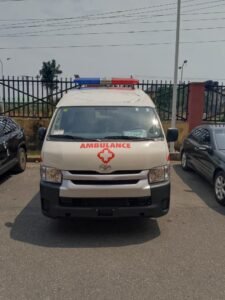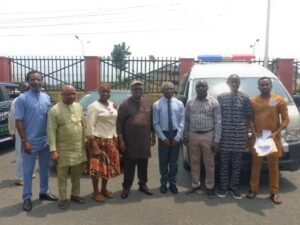
The Vice Chancellor of the University of Calabar, Prof. Offiong Efanga Offiong, has taken delivery of and commissioned vehicles donated under the PRIMS (Pregnancy, Risks, Infant, Measurement and Surveillance) project to support maternal and child health monitoring in Cross River State.
Speaking during the brief ceremony, Prof. Offiong congratulated the research team for initiating a project that directly benefits both the university community and the wider Cross River community.
He noted that the high rate of infant mortality associated with pregnancy-related complications remains a major concern, adding that Cross River State has been identified among the states affected by the challenge based on available statistics.
He described the initiative as one that complements government efforts in addressing maternal and infant health challenges.
“This is one of the projects that directly supports the efforts of the government in tackling maternal and infant mortality. I urge the team to handle these facilities properly and ensure they are effectively utilized,” he said.
Prof. Offiong further stated that the University management has already provided guidelines on how the facilities will be used to ensure they serve their intended purpose.
This is even as he expressed optimism that more development partners would extend similar gestures to the institution, assuring that the vehicles and facilities
would be judiciously used.
Earlier, the Site Lead and Director of the Health and Demographic Surveillance System (HDSS) at the University of Calabar, Prof. Iwara Iwara, explained that the vehicles were provided under a research grant linked to the PRIMS project.
According to him, the project is being implemented in five states across the country including Cross River State, Lagos State, Katsina State, Plateau State and Bauchi State with the aim of monitoring pregnancies and tracking risk factors to ensure safer deliveries for pregnant women.
Prof. Iwara stated that the grant is funded by the Bill & Melinda Gates Foundation, with the coordinating team based at the University of Lagos responsible for providing the equipment required for the project.
He noted that the Cross River team competed alongside other site teams before emerging successful in securing the grant.
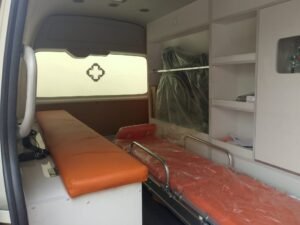
“The grant includes a 2025 model Toyota RAV4 and a fully equipped ambulance fitted with medical equipment to assist women in rural communities.
The ambulance will help ensure that pregnant women who require referrals are promptly transported to hospitals,” he explained.
Also speaking, the Centre Director of HDSS at the University of Calabar, Prof. Martin Meremikwu, noted that research grants often involve intense competition among institutions.
According to him, whenever grants are available, researchers must meet specific criteria in order to be selected.
“In the research domain, there is always the possibility of attraction grants, and when they come, competition is inevitable. When this happens, there are clear criteria for selection, and that is simply what occurred in this case,” he said.
Prof. Meremikwu explained that the University established a Demographic Health Surveillance System in 2012 through funding from Canada, which has continued to provide valuable health data for research and policy planning.
He stated that through the surveillance system, staff members regularly visit homes and families every month in communities across Akpabuyo Local Government Area, Calabar and now Biase Local Government Area.
According to him, the families visited are captured in the centre’s database, enabling researchers to monitor and understand the state of their health over time.
He added that because the University already had a functioning research centre and data system, it was well positioned to compete when the pregnancy monitoring project was opened for bidding.
“So when the project on pregnancy monitoring was advertised, we participated in the bidding process and eventually won the grant. That is why we are here today,” he said.
The PRIMS project is expected to strengthen maternal health monitoring and improve emergency response for pregnant women, particularly in underserved rural communities across Cross River State.
Public Relations Unit
University of Calabar