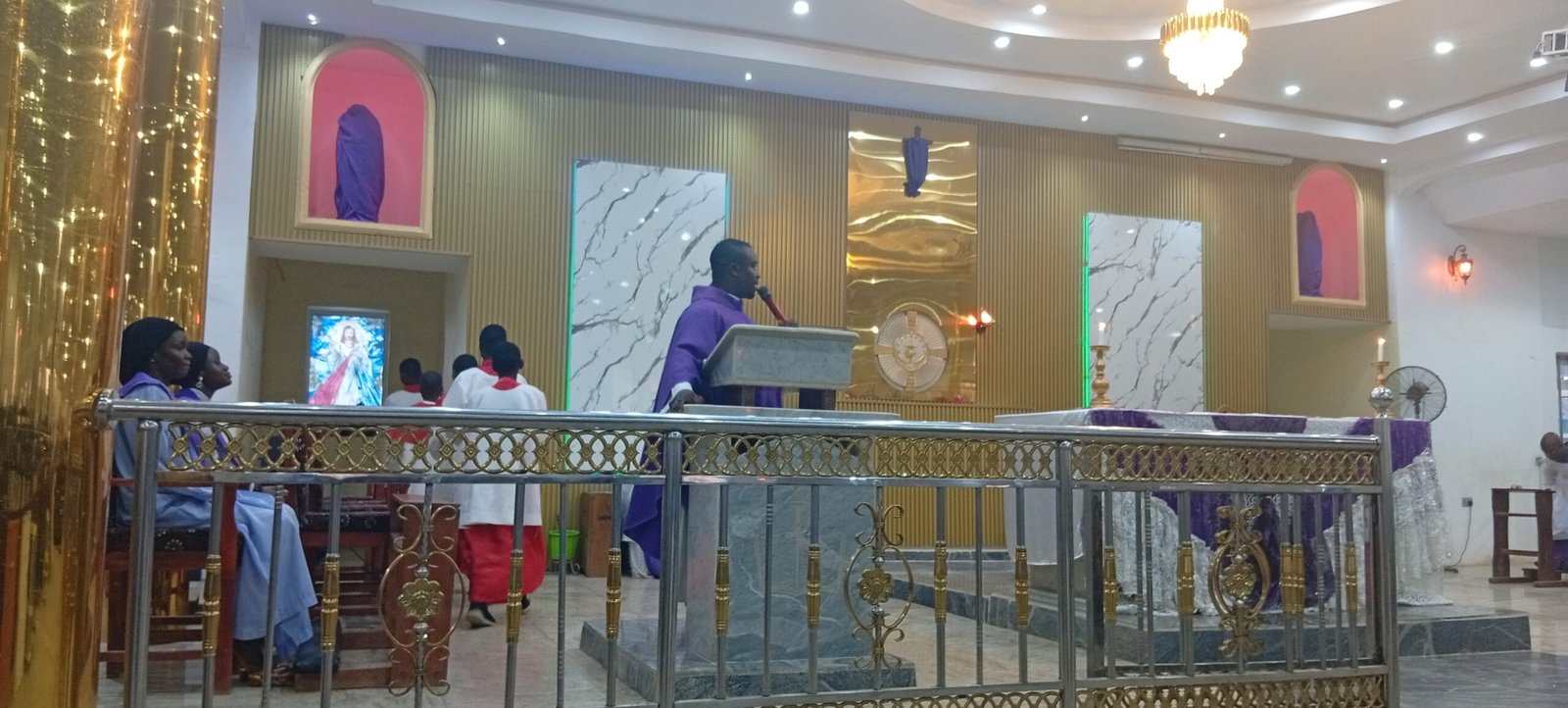
I titled this reflection Come Out. It would have been fitting to call it Lazarus, but the time of Lazarus has passed. I leave the title open, so that you can come out yourself.
When Jesus called Lazarus, His mission was specific: “Lazarus, come out.” But today, from this pulpit, that same call is extended to everyone. Whenever you hear the words come out, it is both an invitation and a command. It may mean: come out and effect change. It may also mean: come out from where you are not supposed to be. There are places we find ourselves that are not meant for us, places of sin, compromise, and moral confusion. When God says “come out,” He is calling us away from those places. The phrase come out involves two people, the one who calls, and the one who responds. It is a command you cannot command yourself. God is the one calling, and we are the ones invited to respond. My dear people of God, the Word of God speaks directly to our situations. It carries the power to bring life where there is decay.
In today’s Gospel, Lazarus had been in the grave for four days. According to Jewish belief, there was still hope within the first few days of death, but after four days, all hope was gone. Yet Jesus came at that moment to show that even when human hope ends, divine possibility begins. That is why Martha said, “I know he will rise again in the resurrection.” And Mary and Martha wept bitterly. When Jesus saw them, He wept.
Jesus did not weep because death existed, but because of the depth of human pain and struggling faith. His tears show that He shares in our suffering. Death, in itself, is not the ultimate problem, it is a necessary passage of life. But God’s power goes beyond even death.
In the first reading from the Prophet Ezekiel, the dry bones represent a people who had lost identity and hope. God asked: “Can these bones live?” He brought the prophet to a valley, a place of depression, a low point, to show that even from the lowest place, restoration is possible. No matter your situation, you too will rise again.
In the Gospel, we see another form of “dry bones” a family that had lost their only hope. Lazarus was everything to Mary and Martha. When he died, it felt like everything was lost. They said, “Lord, if you had been here, our brother would not have died.”
We can say the same today, Lord, if you had been here, our nation would not be like this. Lord, if you had been here, insecurity would not be rising. Lord, if you had been here, things would be different. But even in that pain, we remember the shortest verse in Scripture: “Jesus wept.” This shows that God is not distant, He suffers with us.
Today, however, we see confusion even in the Gospel being preached. Some preach for gain, turning the altar into a marketplace. Truth is fading, and hope seems buried. But the message remains simple, the God who raised Lazarus can restore us. However, there is a condition, we must surrender to Him. Before Lazarus came out, people had to roll away the stone. Jesus performed the miracle, but human beings removed the obstacle.
So we must ask ourselves: what are the stones blocking us today? In our nation, injustice, bribery, and corruption. In our personal lives, hatred, jealousy, gossip, addiction. After Lazarus came out, Jesus said, “Unbind him.” Again, it required community effort.
Transformation is both divine and human. God raises but we must cooperate. Come out of sin. Come out of hatred. Come out of addiction. Come out of hopelessness.
Even when it feels like God is late as it seemed with Lazarus remember this. He is never late. He works beyond human timing.
He loved Lazarus, yet He delayed so that a greater glory could be revealed. Your life is not too late. Your purpose is not lost.
Your situation is not beyond restoration.
When God calls, respond.
Come out and live again.
Disclaimer: The opinion expressed in this article is strictly that of the author, Sylverus Ulem and does not represent Theluminenews, or its agent or the organisation the author works for/with